

Where Carnival comes from
Carnival, as we know it today, has its roots in a Catholic festival, itself influenced by much older European pagan traditions linked to the changing seasons. These celebrations marked the transition from darkness to light, from winter to spring, long before Carnival became the exuberant event we recognise today.
Mardi Gras!
Mardi Gras is traditionally the final and most exuberant day of Carnival. It takes place just before the start of Lent, a solemn period in the Christian calendar commemorating the forty days Jesus is said to have spent fasting in the desert.
Lent begins on Ash Wednesday, when practising Christians may have ashes placed on their foreheads as a symbol of reflection and humility, and ends with Holy Week (Setmana Santa) and Easter. Traditionally, Lent was a time of restraint and self-denial. People would give up certain pleasures, such as meat or alcohol, and children were often encouraged to give up sweets, with the money saved going into a ‘poor box’.
With weeks of restraint ahead, it is hardly surprising that the day before Ash Wednesday evolved into a moment of indulgence. Shrove Tuesday, originally a practical day for using up rich ingredients such as eggs, butter and sugar, gradually became Mardi Gras, literally ‘Fat Tuesday’ in French. Over time, it grew into a full-blown celebration of feasting, music and excess.
Today, Mardi Gras is closely associated with places like New Orleans, where celebrations stretch over several weeks, but at its heart it remains the climactic final day of Carnival.
So what is the difference between Carnival and Mardi Gras?
Strictly speaking, Mardi Gras is not separate from Carnival at all. It is simply the grand finale. Carnival can begin days or even weeks before Mardi Gras, depending on local tradition, and in many modern celebrations, the festivities no longer stop abruptly once Lent begins.
What does ‘Carnival’ mean?
The word ‘Carnaval’ comes from the Latin carne vale, meaning ‘farewell to meat’ or ‘farewell to the flesh’. This reflects the idea of abstaining from meat and other pleasures during Lent. In Italian, the word is still spelt Carnevale, while in Catalan, Spanish, French, Portuguese and Dutch it is Carnaval. In English, it becomes Carnival, and in German Karneval. Different spellings, same spirit.
Carnival is celebrated with varying intensity worldwide, particularly in Europe and the Americas. Some of the most famous examples include celebrations in Brazil, especially in Rio de Janeiro, Salvador and Recife, where entire cities turn into open-air parties. In Europe, major celebrations take place in cities such as Venice, Nice and Cologne.
Spain also hosts some of Europe’s most impressive Carnivals. The best known are held in Santa Cruz de Tenerife and Las Palmas de Gran Canaria in the Canary Islands, as well as in Cádiz in Andalucía.
How the dates work
The date of Carnival changes every year because it is calculated backwards from Easter. Easter itself is a movable feast, falling between 22 March and 25 April in Western Christianity. Lent lasts forty days, not counting Sundays, which is why Mardi Gras always falls on a Tuesday.
In 2026, Easter Sunday falls on 5 April, which means Mardi Gras will take place on Tuesday, 17 February 2026.
Carnival in Spain
Spain’s lively Carnival culture has not always been a given. During the Spanish Civil War in 1937, Carnival celebrations were suspended, and in 1939, the Franco dictatorship officially banned them altogether. Although small exceptions were later made, it was not until 1978 that the prohibition was fully lifted and Carnival returned to public life.
Since then, Carnivals across Spain have grown in scale and confidence. Santa Cruz de Tenerife is often described as the wildest Carnival in Europe, sometimes compared to Rio de Janeiro, although the Canary Islands are, of course, geographically closer to Africa than to mainland Europe.
Las Palmas de Gran Canaria has developed its own distinctive celebrations, while Cádiz is known for its sharp humour, satire and musical performances. Together, these cities underline just how deeply Carnival has reclaimed its place in Spanish cultural life.
Much closer to home in Catalunya is the Carnaval de Sitges, just half an hour by train south of Barcelona. Sitges is known for one of the most elaborate Carnivals in the country, with long-established ‘societies’ competing year after year to outdo each other in colour, creativity and sheer flamboyance.
Carnival events also take place in the city of Barcelona itself, particularly in neighbourhoods such as El Born and La Ribera, but nowhere near on the same scale or intensity as in Sitges. For many in Catalunya, Sitges remains the undisputed reference point for the Carnival spectacle.
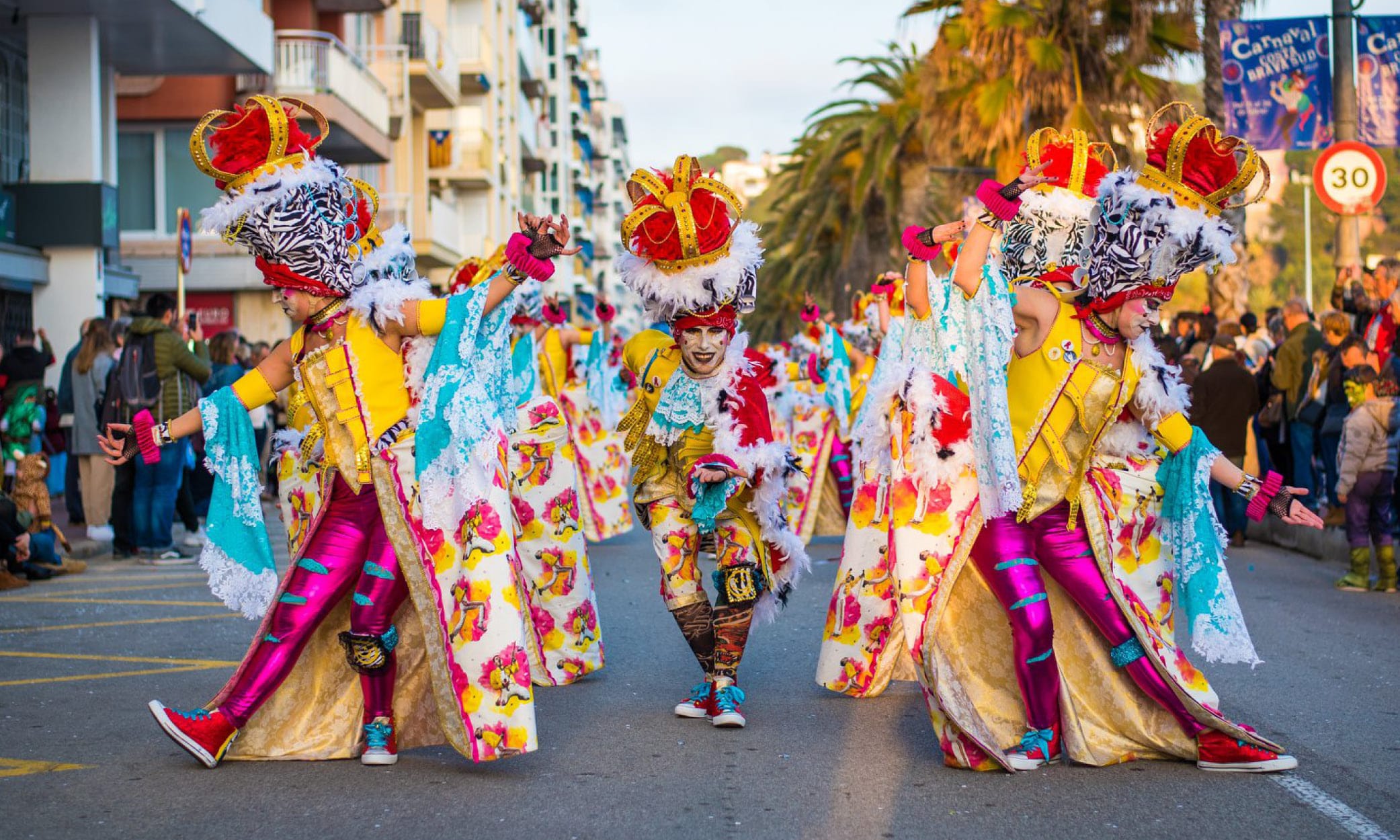
Carnival on La Costa Brava
Here on La Costa Brava, Carnival celebrations may be slightly smaller in scale than in Sitges or Cádiz, but there is certainly no shortage of colour, music and good-natured chaos. In some towns, events last just a day or two, while in others the celebrations stretch out over more than a week.
After the disruption caused by the pandemic, recent editions have fully returned to their traditional form, with street parades, costume competitions and plenty of community spirit. Carnival on La Costa Brava is lively, welcoming and, above all, very local.
Below you will find the Carnival dates for 2026 in a selection of Costa Brava towns. Where available, town names link to official programmes. A small number of dates may still be subject to final confirmation, and we will update this page as soon as new information becomes available.
Cadaqués: 13–17 February
Roses: 12–16 February
L’Escala: 13–16 February
L’Estartit: 13–15 February
La Bisbal d’Empordà: 8–22 February
Pals: 7 February
Begur: 8–18 February
Palamós: 7–18 February
Calonge – St. Antoni: 5–24 February
Platja d’Aro – S’Agaró: 7–18 February
Sant Feliu de Guíxols: 7–18 February
Lloret de Mar: 13–15 February
Tossa de Mar: 13–28 February


Carnival is always a particularly colourful time in Platja d’Aro, with elaborate costumes and large parades that draw visitors from across the region.
Behind the scenes, an enormous amount of work goes into preparing Carnival outfits, floats and performances. While Castell–Platja d’Aro usually hosts the largest Carnival on La Costa Brava, the overall atmosphere here remains friendly and inclusive, with many events designed specifically for children and families.
El Gran Despertà
One event that is definitely not aimed at children is El Gran Despertà, literally ‘The Great Awakening’. Not every town celebrates it, but Palamós famously does. At around 6 am, trucks drive through the streets blasting music at full volume, waking the entire town and officially kick-starting the day’s festivities.
Later in the morning, participants traditionally head to the sea for a refreshing dip, before continuing the celebrations at the Town Hall and municipal market. The morning usually ends with a large communal meal around midday, once appetites have been thoroughly worked up.
Burying the Sardine
You might notice that some Carnival events continue beyond Mardi Gras. This is partly because modern celebrations are less strictly tied to religious calendars, but also because of a long-standing local tradition: El Entierro de la Sardina, or L’Enterrament de la Sardina in Catalan, which takes place on Ash Wednesday.
Literally translated as ‘The Burial of the Sardine’, the event is a parody funeral procession marking the symbolic end of Carnival. Originally, meat representing excess and indulgence was buried to signal the start of Lent. Today, the sardine is more likely to be grilled and eaten than buried.
The procession is deliberately theatrical, humorous and slightly absurd, often ending with the burning or burial of the sardine. The most famous version takes place in Murcia, where celebrations continue the week after Easter, offering a second chance to experience this curious tradition if you miss it elsewhere.